

When you want to understand the surface characteristics of a material, BET surface area analysis offers a reliable method. You’ll start by properly preparing your sample and then move through precise steps involving gas adsorption at low temperatures. Each phase impacts your results, and knowing how to navigate them ensures accuracy. But before you get to interpreting numbers gas adsorption analyzer, it’s important to grasp what happens behind the scenes during the measurement process.

What BET Surface Area Analysis Is and How It Works
Understanding what BET surface area analysis is and how it works is essential if you want to accurately measure the surface area of porous materials. BET stands for Brunauer-Emmett-Teller, the scientists who developed this technique.
It measures the amount of gas, usually nitrogen Lab Alliance, that adsorbs onto a material’s surface at low temperatures. By analyzing how much gas sticks to the surface, you can calculate the total surface area, including pores and crevices.
This method relies on physical adsorption, where gas molecules form a thin layer on the material. The more surface available, the more gas is adsorbed.
Knowing this helps you understand material properties like reactivity or strength. You get precise insight without altering the material, giving you freedom to explore its true characteristics.
Preparing Samples for BET Surface Area Testing
Start by carefully preparing your samples to ensure accurate BET surface area measurements. You’ll want to remove any contaminants or moisture that might skew your results.
Here’s how you can get your samples ready:
- Dry your samples thoroughly, often using a vacuum or gentle heating.
- Grind bulky materials into a fine, uniform powder for consistent surface exposure.
- Avoid contamination by handling samples with clean tools and gloves.
- Store prepared samples in airtight containers to preserve their state before testing.
How to Perform BET Surface Area Measurements
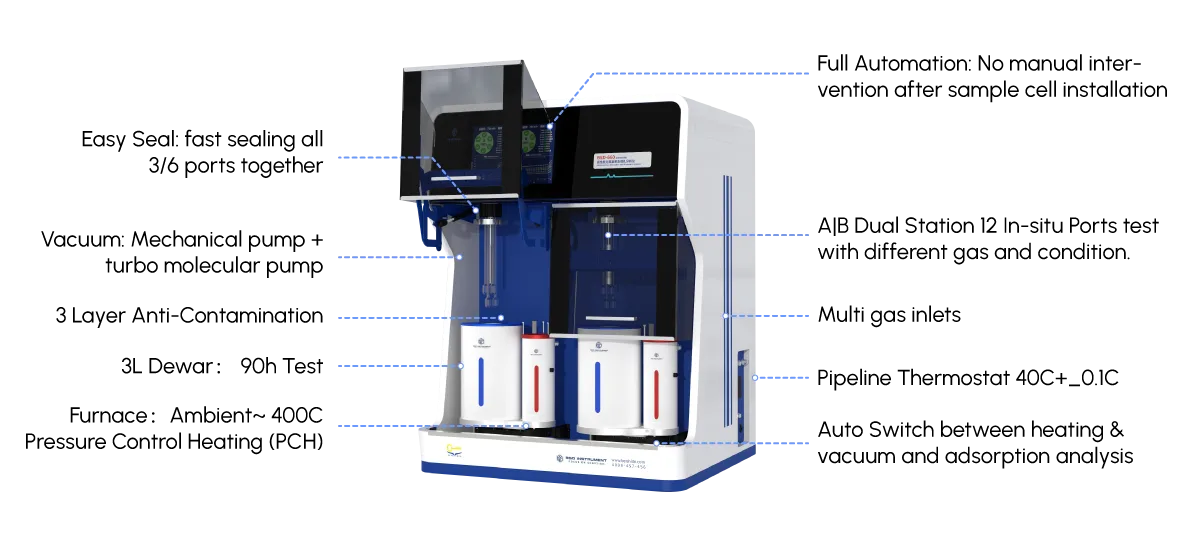
Begin by placing your prepared sample into the BET analyzer’s sample holder, ensuring it’s secure and properly positioned.
Next, evacuate the system to remove any adsorbed gases or moisture that could skew your results.
Then, introduce an inert gas—usually nitrogen—at liquid nitrogen temperature to allow it to adsorb onto your sample’s surface.
The analyzer measures the amount of gas adsorbed at different relative pressures, so you’ll monitor the pressure changes carefully during this step.
Once the adsorption data is collected, the instrument calculates the monolayer capacity, which directly relates to your sample’s surface area.
Throughout the process, keep an eye on system stability and calibration to guarantee reliable measurements.
You’re now ready to capture precise BET surface area data with confidence.
Interpreting BET Surface Area Results
Once you’ve collected your BET surface area data, interpreting the results accurately becomes essential to draw meaningful conclusions about your sample’s properties. You’ll analyze key values like surface area, pore volume, and adsorption characteristics to understand how your material behaves.
Keep these points in mind as you interpret:
- A high surface area often means greater reactivity or adsorption capacity.
- Unexpected low values might hint at sample contamination or structural collapse.
- Comparing results against known standards helps validate your measurements.
- Surface area trends reveal how treatments or changes impact your sample.
Troubleshooting Common BET Surface Area Issues
Understanding how to interpret your BET surface area results is just one part of the process; you’ll also need to identify and resolve common issues that can affect the accuracy of your measurements.
Start by checking for sample contamination or moisture, which can skew adsorption data. Ensure your degassing step is thorough—any residual gases can throw off results. Watch out for improper pressure range selection during analysis; using the wrong range can lead to incorrect surface area calculations.
If your BET plot isn’t linear, revisit your assumptions or sample prep. Calibration errors with your instrument also cause inconsistencies, so regularly verify its performance.
Conclusion
Now that you know how BET surface area analysis works, you’re ready to get accurate measurements by properly preparing your samples and following the testing steps carefully. Paying attention to details like cleaning, drying, and controlling the pressure will help you get reliable data. When interpreting results, remember the BET equation’s role in calculating surface area and pore characteristics. If issues arise, troubleshooting common problems will keep your analysis on track and efficient.


